
Vetting Suppliers for a Niche Range Headed to a Department Store
A niche brand heading into a department store is buying small volumes against high expectations, and that combination exposes suppliers quickly. A mass-market buyer can absorb a supplier's weak point because volume hides it; a niche brand cannot, because a distinctive scent, a short run and a visible retail placement leave no room for a substitution that was not discussed. The scorecard below is built for that situation, and its purpose is to produce evidence rather than impressions.
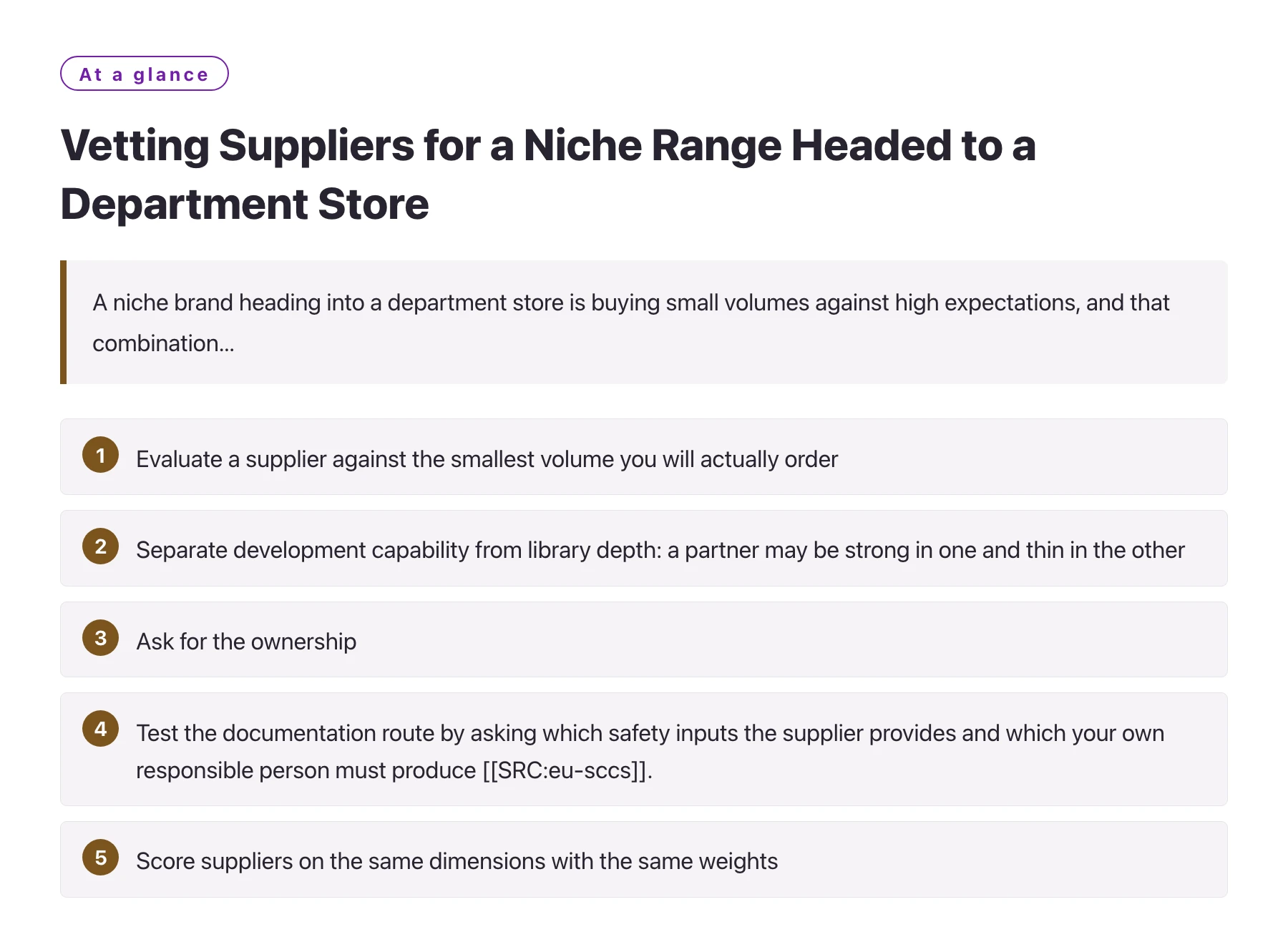
Key takeaways
- Evaluate a supplier against the smallest volume you will actually order, not the largest, because that is where the fit is decided.
- Separate development capability from library depth: a partner may be strong in one and thin in the other, and the two answer different briefs.
- Ask for the ownership, exclusivity and confidentiality position in writing before sharing your brief, since a niche position depends on it [1].
- Test the documentation route by asking which safety inputs the supplier provides and which your own responsible person must produce [2].
- Score suppliers on the same dimensions with the same weights, or the choice becomes a preference for whoever presented best.
Niche brands often evaluate suppliers the way a large buyer would, using a checklist built for volume programmes, and then discover that the questions do not fit. What matters at a small volume is not capacity but flexibility: whether a supplier will run a short batch, whether it will adapt a formula without treating the change as a new project, and whether it will say no clearly when a request is impractical.
A department store listing raises the stakes in a specific way. The range becomes visible, the packaging is scrutinised, and the retailer may ask for documentation that a direct-to-consumer brand was never required to produce. A supplier that is comfortable at that level is worth more than one that is merely cheaper.
The scorecard below is intended to be filled in during conversations, before any sample is commissioned. Its value is comparative: one supplier's answers mean little on their own, but five sets of answers on the same dimensions produce a clear picture.
The evaluation scorecard, with the evidence that counts
| Dimension | What to ask | What demonstrates a real answer |
|---|---|---|
| Fit at your volume | What is the genuine minimum for a bespoke direction, and what changes at that quantity | A specific quantity with the reason behind it, rather than a minimum that is negotiable if you push |
| Development capability | How many directions a development fee covers, and who does the work | A named development contact, a defined brief format, and an explanation of what happens when directions are exhausted |
| Library depth | Which existing directions are close to your positioning, and under what terms they can be used | Samples offered without a fee, a clear licence position, and honesty about how widely a direction has been used |
| Ownership and exclusivity | Who owns the composition, what rights you receive, and what happens on termination [1] | A written position provided before you share the brief, covering ownership, permitted use and confidentiality |
| Documentation route | Which safety inputs, test results and labelling inputs the supplier provides [2] | A list separating what the factory supplies from what the brand must commission, with the format each item arrives in |
| Consistency mechanism | How a reorder is compared with the approved batch, and for how long a reference is retained | A described procedure: storage conditions, retention period, comparison step and what happens outside tolerance |
| Small-scale packaging skill | Whether decoration and assembly options exist at your quantity without bespoke tooling | Stock components with tested decoration routes, and a realistic statement about which finishes need tooling |
| Honesty signals | Where the supplier says no, and to what | At least one considered refusal, with a reason and an alternative, rather than agreement to everything |
The last row is the one most buyers neglect, and it is often the most predictive. A supplier that agrees to every request has either not understood the brief or intends to resolve it later in its own favour. A supplier that declines a request and explains why is demonstrating the same judgement you are paying for during development. If your scorecard produces two closely matched candidates, that row is a reasonable tie-breaker, and it is worth comparing against how a published evaluation guide frames the same question Xuelei's guide.
Three questions that reveal more than the checklist
Scorecards are useful for comparison, but three questions cut through faster if time is short. Each one asks for a behaviour rather than a capability, which is harder to present well without having it.
The first is to ask what the supplier would do if a material in an approved formula became difficult to obtain. The answer describes how the relationship will actually work: whether you will be told before a substitution is made, and whether the change is documented against the approved reference.
The second is to ask for a recent example of a project that did not go smoothly, and what changed afterwards. A supplier with any history has one, and the willingness to describe it is a signal about how problems will be handled when the launch calendar tightens. Any careful approach to how to compare perfume factories includes a version of this, because it separates a rehearsed presentation from an operating business.
The third question: what do you need from me
Asking what the supplier needs from the brand, and when, reverses the direction of the conversation and produces a schedule rather than a brochure. Good answers are specific: a locked brief by a certain date, a packaging decision before stability testing, artwork approved before filling is scheduled.
That list is also the practical basis for the project plan. A brand that receives a clear list of dependencies from two suppliers has effectively compared their project management without asking about project management at all.
Scoring, not shopping
The failure mode for a niche brand is collecting suppliers rather than comparing them. Conversations stay exploratory, each supplier is judged against the last one's best answer, and the decision is made on the strength of the final meeting. The remedy is procedural: fix the dimensions and their weights in advance, fill in the scorecard for every supplier before discussing the next, and keep a short note of the reasoning behind each score.
Weighting matters as much as the dimensions. A niche brand preparing for a visible retail listing should usually weight documentation, consistency and ownership more heavily than price, because those are the areas where a problem becomes public. Price differences at small volume are real but rarely large enough to justify a weaker position on any of the other three.
The final discipline is to record what would change the decision. If a supplier scores lowest on volume fit but the launch could start with a smaller opening order than expected, the ranking might reverse. Writing that condition down keeps the evaluation honest and makes the next round of conversations much faster.
For a niche range, treat the ownership and documentation position as the first filter and everything else as secondary, because those are the two areas that cannot be repaired after the launch. A brand that has already shared its brief and its formula direction has lost most of its negotiating position on both. Doing the same due diligence on a small scale as a large buyer would, in the order set out in any sensible approach to due diligence on a perfume manufacturer, is the cheapest insurance available, and asking to see documented examples of fragrance projects is a reasonable way to check whether the answers you receive match the work the supplier actually does.
Sources
- WIPO — World Intellectual Property Organization —— The UN agency for intellectual property; resources on industrial design and patent protection relevant to product and packaging design.
- EU Scientific Committee on Consumer Safety (SCCS) —— The EU scientific committee that issues opinions on the safety of cosmetic ingredients, including fragrance allergens and their labelling thresholds.
Frequently asked questions
How many suppliers should a niche brand evaluate?
Enough to produce a comparison, which in practice means three to five. Fewer than three tends to produce a decision based on the strength of one presentation; more than five rarely adds information once the scorecard dimensions are covered.
Should price be weighted heavily in the scorecard?
For a niche launch into a visible retail channel, usually not. Documentation, consistency and ownership tend to matter more, because failures there become public and expensive. Price should still be scored, but as one dimension among several rather than as the decision.
What if a supplier refuses to discuss ownership before seeing the brief?
A reasonable supplier can describe its standard position on ownership, exclusivity and confidentiality without seeing the brief itself. A refusal to say anything at all at that stage is worth noting, since the terms matter most before the brand has disclosed its direction rather than after.
How can a small brand check consistency claims?
Ask how a reorder is compared against the approved batch, where the reference is stored, and for how long. Then ask what happens when the comparison falls outside tolerance. The existence of a described procedure is the answer; a promise of consistency without a procedure is not.
Is a smaller specialist supplier a better fit than a larger manufacturer for a niche range?
It depends on where the brief needs strength. A specialist may be more flexible at small volume and more engaged with a distinctive direction, while a larger manufacturer may be stronger on documentation, consistency and packaging at scale. The scorecard approach exists precisely because the answer varies with the brand's weighting.
Read this week's briefing
Original reporting on Arab women in business, policy, and capital — read by ministers, founders, and fund managers across 31 countries.
Join the Network